

Linguistic Overview
Classifying Modals
Modal verbs have the following characteristics:
- They can express modality. Instead of simply stating what is or what happens, modality communicates the speaker’s perceptions, beliefs, values, and understanding of the situation.
- They are polysemous: they have multiple meanings depending on the flavor applied. Also, each of the core modals can be used for all four of the primary flavors.
- They can only come in the Bare Infinitive form, or the base verb form. In fact, they are unable to take on any other verb form, and so are described as defective.
- Within its verb string, the following verb must also be a Bare Infinitive (or the base verb form), whether that is the main verb or another auxiliary verb.
- They cannot be the main verb of their clause. They can also never be used as verbals.
In addition to the specific properties above, the core modals (also called ‘modal auxiliaries’) are a subset of auxiliary verbs and therefore also have all the same properties as all other auxiliaries:
- They can host negators and can even be joined with not to create contractions (like “couldn’t“).
- They can participate in ellipsis expressions (like short answers);
- They can participate in subject-auxiliary inversion for certain situations, like most question forms; as an extension, core modals can immediately follow ‘WH’-words.
Finally, all modals carry meaning. Contrast this with the auxiliary DO, which carries no real meaning but only serves a grammatical function.
Quasi-Modals
Marginal Modals, or ‘semi-modals’, are words and idioms that meet most but not quite all of the qualifications of modal verbs. They’re also less commonly-used than the core modals (and need is even considered archaic). The marginal modals are:
dare • had better • need • ought [to] • would rather
Linguistically, marginal modals just barely miss the mark of modal auxiliaries: they can’t be main verbs and they can host negators, among other things; but they can’t work as ellipses (for instance we can’t say, “Yes, I dare,” or “So would rather I,“) like auxiliaries can, and they’re not polysemous. Nevertheless, they still function in mostly the same way as the core modals, and so they will be featured throughout this article.
Pseudo-Modals are words or phrases that hold some properties of modal verbs (and express modality) and some properties of main verbs, and thus are caught in the middle. They are not defective, and they are followed by Full Infinitives instead of Bare Infinitives. Although they hold fewer modal properties than marginal modals, they are more commonly used in modern English.
Teaching Modals
Coursebooks and other grammar references tend to have several different categories of Modal verbs, which makes it seem as if there are a wide range of topics that students must learn, just for modals! But most curricula really only focus on three flavors:
- Modals of Ability (a subset of the Praxic flavor)
- Modals of Possibility & Probability (the Epistemic flavor)
- includes Modals of Deduction and Modals of Expectation
- Modals of Permission, Advice, & Obligation (the Deontic flavor)
- includes Modals of Restriction, Modals of Prohibition, Modals of Rebuke/Regret, and more
Additionally, Volitional modals are featured in many constructions of Future Plans.
It might be helpful for students if you group modals of advice, permission, obligation, etc. into one lump (Deontic). You can call this category whatever you like (since the term ‘deontic’ isn’t the easiest to remember), such as ‘Regulatory Modals’ or ‘Modals of Requirement’, but keeping them together might help students see the similarities and differences between them. It should also feel less daunting to learn three flavors than twice as many disparate smaller categories.
Facets of Modality
Modal Flavors
Each of the core modal verbs has multiple meanings. For example, could might refer to a statistical possibility, to permission, to an ability, or more. But most of these meanings align with similar meanings that other modals share. A modal flavor is a category of meaning across modal verbs.
There are four primary or extensive flavors in which every core modal has a meaning. Some marginal modals and pseudo-modals have meanings in these flavors as well. These flavors also align firmly with some of English’s moods. The primary flavors are Epistemic, Deontic, Alethic, and Volitional.
- Epistemic Modality conveys speculations of likelihood, or what the speaker believes to be true or feasible. It’s typically expressed as Possibility & Probability. In addition to the nine core modals, we might use ought [to], have got to, or have to in this flavor.
- Deontic Modality conveys regulations, which may include anything from strict laws to social norms to best practices. It’s typically expressed as Permission, Advice, & Obligation, though there are other applications. In addition to the nine core modals, we might use had better, need, ought [to], be to, get to, have got to, have to, or need to in this flavor.
- Alethic Modality conveys an intrinsic quality of the subject and set the verb phrase in a realis mood. Examples include “This old staircase can be treacherous,” and “a story must have a beginning, middle, and end.” Alethic modality is rarely ever taught in ELT.
- Volitional Modality conveys what the agent is ready or planning to do. It’s typically expressed as Willingness & Intent. In addition to the nine core modals, we might use dare, would rather, care to, or have got to in this flavor.
Furthermore, there are secondary or exclusive flavors which have very narrow applications and for which not every core modal has a meaning. The list of secondary flavors is less definitive, but Insights to English recognizes the following:
- Bouletic for wishes or fears [have to, may, and ought to]
- Hypothetical for imagined situations
- Counterfactual for situations that are certainly untrue [should and would]
- Tentative for realistic yet uncertain future situations or outcomes [may and should]
- Praxic for what the agent puts into practice
- Modals of Ability & Capacity [can and could]
- Modals of Habit [can/could, might, will/would, tend to, and used to]
- Putative for the speaker’s emotional reaction (like surprise or disbelief) [should & would]
Keep in mind that there are not firm distinctions between modal flavors; some instances of a modal auxiliary may be ambiguous as to which flavor is intended, or they may even apply to multiple flavors simultaneously (for instance, “I could help you with that,” indicates both the agent’s capability and their willingness).
Identifying modal flavors is important because modals sometimes play by different rules — such as what Perfect Modals indicate, how negation works, or which periphrastic substitutes apply — depending on which flavor is applied.
Modal Force
Modal Strength
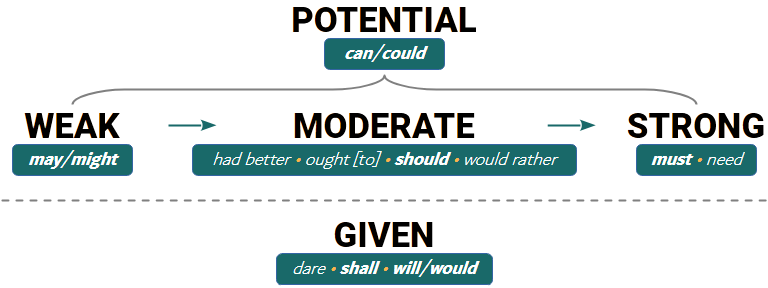
Force is the type of stance that the speaker takes. Modal strength in particular broadly determines how strong their convictions are or how strongly they wish to enforce their ideas. Each modal pair aligns with a certain modal force that is consistent across all of its flavors.
- Potentiality (enabling force) — possibility, permission, willingness, ability, etc.
- can & could, along with get to
- Weak Force (granting force) — low likelihood, permission, hesitant willingness, etc.
- may & might
- Moderate Force (guiding force) — high likelihood, suggestions, suppositions, etc.
- should, along with care to, had better, ought [to], and would rather
- Strong Force (compelling force) — certainties, obligation, compulsions, etc.
- must, along with have to, have got to, need, need to, and tend to
- Givens (asserting force) — assumptions, mandates, schedules, etc.
- shall, will, & would, along with be to, dare, and used to
The concepts of weak, moderate, and strong should be fairly straightforward. Potentiality encompasses the rest as a pre-requisite (for example, a situation has to be possible before it can be probable). Meanwhile, givens are meant to remove ambiguity from the outcomes (at least in the speaker’s own mind).
Modal Source
Source, aka motivation, is either internal or external, and it’s either subjective or objective.
- An internal source means the convictions come from the speaker, perhaps because they are rooted in the speaker’s reasoning capabilities or their values. An external source means the speaker is influenced by other factors, such as compelling evidence or authoritative regulations.
- Biased, or subjective, sources are based on the power of people involved, like authoritative regulations, the speaker’s reasoning, or the agent’s disposition. Unbiased, or objective, sources are based on the nature of the thing, like circumstances, evidence, or the agent’s capacity.
We won’t explore source very deeply in this article, but it’s worth mentioning since source is the distinguishing factor between certain sets of modal expressions. For instance, can and may both communicate permission in the Deontic mood, but can relies on an external authority while may is rooted in the speaker’s own internal authority. Similarly, have to and need to are both considered synonyms of must, but have to is subjective while need to is objective.
Forms
Modals and What Follow
Modal verbs can only come in their base form (i.e. the Bare Infinitive form). They cannot take any other form, and therefore are called ‘defective’:
- Modals can’t be expressed as a Full Infinitive (the to ___ form), an Active Participle (the -ing form), or a Perfect/Passive Participle (the -ed/en form).
- They cannot be inflected according to the number of person of the subject, like by adding an -s suffix. (Subject-verb agreement doesn’t apply to modals.)
- For instance, the modal may always comes in the form of ‘may’, no matter the circumstance. It’s never ‘
mays‘, ‘mayed‘, ‘maying‘, or ‘to may‘.
Modal verbs can only ever be the first verb in their verb string. They do not follow after other auxiliary verbs, including other modals. Certain dialects allow double-modals like “might could”, but they are generally not accepted in standard British or American English.
Whatever verb follows in that verb string, whether another auxiliary or the main verb, must also be in the base form (or the Bare Infinitive). Consider the underlined verbs in these examples:
- can see
- couldn’t have forgotten
- may not continue
- might be captured
- must be joking
- shall depart
- will have been practicing
- would never know
Notice that while there are a range of verb constructions — some of which are Perfect, Continuous, or Passive — modal verbs are only ever at the very front of the verb string.
Negation
When negators are present, they come immediately after the modal verb in most cases. If the negator is not, it can be contracted with any modal except for may, though the contracted form mightn’t is rare, especially in American English. Shall and will undergo morphological changes to form shan’t and won’t, respectively. The modal can is unique in that it can also be bound with not without a contraction to form the word cannot.
| Modal Verb |
Subjectal Contraction |
Perfect Form | Negated Form |
|---|---|---|---|
|
can |
– |
can have |
can’t / cannot |
|
could |
– |
could’ve |
couldn’t |
|
may |
– |
may’ve |
may not |
|
might |
– |
might’ve |
might not |
|
must |
– |
must’ve |
mustn’t |
|
shall |
‘ll |
shall have |
shan’t |
|
should |
– |
should’ve |
shouldn’t |
|
will |
‘ll |
will have |
won’t |
|
would |
‘d |
would’ve |
wouldn’t |
|
dare |
– |
n/a |
daren’t |
|
had better |
‘d better |
(had) better have |
had better not |
|
need |
– |
need’ve |
needn’t |
|
ought to |
– |
ought to’ve |
ought not (to) |
|
would rather |
‘d rather |
would rather have |
would rather not |
The third and fourth columns show contracted forms if they are in common use. Regardless of what is shown in this table, a non-contracted form is always acceptable.
The inclusion of the words in parentheses in this table are generally optional and may be dependent upon dialect.
Marginal Modals
The terms dare, had better, need (archaic), ought [to], and would rather technically don’t qualify as auxiliary verbs, but otherwise they act the same way as modal verbs do, for the most part.
- They are defective and cannot take other forms, including the -s or -ing endings.
- The verb that follows should be in its Bare Infinitive form (though it could be argued that ought should be followed by a Full Infinitive).
To negate these marginal modals, we can simply add not after these terms, as in, “She dare not breathe”; “You needn’t worry so much”; or “We ought not to have done that.”
| Core Modals | Marginal Modals | Pseudo-Modals | |
|---|---|---|---|
|
FORM |
Core and marginal modals only ever come in their base form (never ‘ |
Pseudo-modals inflect according to subject-verb agreement and tense, just like any normal verb (eg: get to might be ‘get to’, ‘gets to’, or ‘got to’). |
|
|
FOLLOWING VERB |
The verb that follows a core modal, or the marginal modals dare, had better, need [archaic] or would rather, must come in its Bare Infinitive form. |
The verb that follows ought or any pseudo-modal must come in its Full Infinitive form (with a ‘to’). |
|
|
INTERROGATIVE |
Core and marginal modals come before the subject for Yes/No Questions and some ‘WH’ Questions. |
Some form of DO needs to come before the subject, which is then followed by a pseudo-modal, for Yes/No Questions and some ‘WH’ Questions. |
|
|
ELLIPSES |
Core modals alone can represent the full verb phrase in short answers, Question Tags, etc. |
Marginal and pseudo-modals cannot represent full verb phrases. For short answers, Question Tags, etc., we need a standard auxiliary instead, usually DO. |
|
|
NEGATIVE |
not or never should come after core and marginal modals. |
not or never should come after some form of DO, which comes before pseudo-modals. |
|
|
PAST |
Perfect Modals: Place ‘have’ (can be contracted) after distal core modals and marginal modals. The following verb should be in its Perfect Participle form. |
Pseudo-modals take their lexical past forms: ‘was’/’were’, ‘cared’, ‘got’, ‘had’, ‘needed’, or ‘tended’.* |
|
* have got is only used for the immediate future; used is already past.
Perfect Modals
Both core modals and marginal modals can be followed by the auxiliary HAVE to form what Insights calls Perfect Modals. Perfect Modals may double in establishing the Perfect Aspect of tense, but they might also have other meanings depending on the modal flavor:
- For the Epistemic and Deontic flavors, Perfect Modals set the verb phrase in the Past; in fact, it’s difficult to express these modals as Past without the accompanying HAVE.
- For the Volitional flavor, it relies heavily on context, but Perfect Modals are likely to express either Future-in-the-Past or Future Perfect.
- For the Dispositional flavor, Perfect Modals communicate the unreal mood. While could is used for past abilities and would is used for past habits, could’ve and would’ve are used for corresponding hypothetical situations.
The HAVE auxiliary in Perfect Modals is always in its base form ‘have’, though it can come in its contracted form ‘ve at the end of the modals or marginal modals (though it’s awkward to do so after the proximal modals can, shall, and will; and with ought, it should come after to).
The verb that follows HAVE (and that is a part of the same verb string) should be in the Perfect Participle form.
Catalog
Some of the core modals come in pairs — including can & could; may & might; and will & would — in which both modals in a pair convey the same modal force. Shall and should have traditionally been considered another pair, but in modern English they are quite different from one another. The first of each pair (can, may, shall, and will) is call the ‘proximal’ modal and is typically the firmer option. The latter of each pair (could, might, should, and would) is call the ‘distal’ modal and is usually more deferential or more hypothetical to its counterpart.
All of the core modals apply to each primary flavor (and maybe some of the secondary flavors), maintaining a consistent modal force across those flavors.
Can & Could
The modals can and could express potential.
Can is a unique word in that it has a negated form of “cannot” (though it can also be expressed as the more standard contracted form of “can’t”).
| Epistemic | Deontic | Volitional |
|---|---|---|
| Potential epistemic modals communicate possibility. | Potential deontic modals communicate permission. | Potential volitional modals communicate willingness. |
| eg: “The package could arrive any day now.” | eg: “We can’t leave until the bell rings.” | eg: “Could you pass the salt, please?” |
| could is more likely than can to be unreal | could is more polite or hesitant than can | could is more polite than can |
As positives, can and could enable verbs that encompass the wide range of options in modality — modality that can then be more specifically defined by weak, moderate, or strong modals. Potential modality is a prerequisite: a situation must be possible before it can be likely ; an action must be permitted before it can be advised.
But by contrast, the negatives “can’t” (or “cannot“) and “couldn’t” are very restrictive, expressing impossibilities. For example, if Dora can’t open a door, then it’s moot to consider whether she should, must, or will open that door, since those options are closed off to her.
While most modal auxiliaries don’t inherently indicate a past tense, could is unique in that it can be past — even without its Perfect Modal form — for certain flavors: in the Deontic flavor, couldn’t indicates a past prohibition (only as a negative); in the Praxic flavor, could usually indicates a past ability.
Common substitute phrases for can and could are be able to, be allowed to, and be permitted to.
Praxic
These can also be Modals of Tendency, as in “Toddlers can be quite the handful!”
But can and could are perhaps best known for being the Modals of Capability (ability & capacity). Here, they continue to convey potential by stating what the subject is capable of, whether it’s a natural ability, a learned skill, time in their schedule, etc. For example, “She can juggle five items at once.” Can is present or tense-neutral while could is best used for past. The most common periphrastic substitute phrase is be able to.
May & Might
The modals may and might convey weak force.
| Epistemic | Deontic | Volitional |
|---|---|---|
| Weak epistemic modals communicate slight probability or unconfident likelihood. | Weak deontic modals communicate requests, tolerance, or mild suggestions. | Weak volitional modals communicate apathetic or indecisive intentions. |
| eg: “The package might‘ve arrived already.” | eg: “May I see that photo, please?” | eg: “I may go to the museum tomorrow.” |
| might is more likely than may to be unreal | might is more reluctant than may | might is more ambivalent than may |
In many situations, may/might can be used interchangeably with can/could, though one of the key differences is that can/could has an external force, meaning it is not decided by the speaker, while may/might has an internal or personal force, meaning it is decided by the speaker. For example, “The apocalypse could begin tomorrow,” merely indicates that the speaker acknowledges it’s technically possible, while “The apocalypse might begin tomorrow,” suggests that the speaker has thought about the matter and has come to a personal conclusion. For another example, a parent may tell their child “You can eat ice cream,” after confirming they aren’t lactose intolerant, or instead say “You may eat ice cream,” as a reward for good behavior.
May and might are unique among the core modals in that their negative forms (“may not” and “might not“) negate the modality instead of negating the main verb. For instance, “Frank couldn’t have finished yet,” tells us that Frank almost certainly did not finish his task, but “Frank might not have finished yet,” tells us that the speaker doesn’t know one way or the other; finishing and not finishing are equally possible.
Praxic
The modal might is occasionally used for habits, but typically ones that are less consistent. For example, “After dinner, she might read a book or go for a walk until her favorite talk show came on.”
Bouletic
The modal may is also used to express the speaker’s desires, as in “May the Force be with you,” or “May God save the queen!” The Bouletic may is very uncommon outside established expressions like these.
Tentative
The phrase “… come what may” means something like “regardless of whatever happens”.
Must
The modal must conveys strong force.
| Epistemic | Deontic | Volitional |
|---|---|---|
| Strong epistemic modals communicate adamant certainty, often thru deduction. | Strong deontic modals communicate obligation or prohibition. | Strong volitional modals communicate compulsion. |
| eg: “The package must‘ve arrived while it was raining.” | eg: “You must put your pencils down now.” | eg: “I must admit, I’m impressed!” |
Must is the height of conviction while still acknowledging that the situation is not set in stone or confirmed yet; someone who uses must is unlikely to change their mind.
The Volitional must is fairly uncommon. But must is often representative of the Deontic flavor since it so strongly encapsulates a sense of obligation (or, as a negative, prohibition).
This modal is often replaced with the marginal modals have, have got, or need (in which case the following verb is a Full Infinitive, as in “You need to put your pencils down now!”). Other common substitutes include the phrases be obligated to and be required to.
The negation of the Deontic must (in the form of “must not” or “mustn’t“) is not the lack of obligation, but rather the obligation not to do something, akin to forbiddance. We can express the lack of obligation using the pseudo-modal substitutes, as in “You don’t need to put your pencils down yet.”
Shall
The modal shall conveys an insisting force similar to will, but with limited applications.
For it’s negative contracted form, we use “shan’t” (not “shalln’t“).
| Epistemic | Deontic | Volitional |
|---|---|---|
| The epistemic shall communicates formal predictions. | The deontic shall communicates decrees, often in a legal context. | The volitional shall communicates immediate intentions. |
| eg: “When shall we be notified of the test results?” | eg: “The defendant shall issue a public apology.” | eg: “Shall we begin now?” |
Shall is unique in that it works best with 1st-person subjects (‘I’ or ‘we’), at least for the Epistemic and Volitional flavors. Also, it is regarded as formal in virtually all contexts.
The Epistemic shall is extremely rare nowadays. The Deontic shall is featured in legal speech as in court cases or contracts, but is uncommon otherwise. Only the Volitional shall is likely to be heard in modern conversations, and even then it still sounds formal (though it might be playfully so).
In contrast to will (which carries personal conviction), the use of shall is often externally motivated, such as by law or some other 3rd-party, and thus may be spoken dispassionately. Shall statements typically carry enough authority that they are rarely questioned.
Shall (proximal) and should (distal) have traditionally be regarded as a modal pair. However, they have drifted apart from one another in modern English – in terms of both meaning and usage – such that they are worth considering independently from one another. However, you may find these two to share a closer relationship in older texts such as classic literature. Furthermore, we might still backshift from shall to should, as in Reported Speech. Otherwise, we’ll regard them separately.
Should
The modal should conveys moderate force.
| Epistemic | Deontic | Volitional |
|---|---|---|
| Moderate epistemic modals communicate reasonable likelihood. | Moderate deontic modals communicate suggestions and criticism. | Moderate volitional modals communicate fairly firm intentions. |
| eg: “Shouldn’t package have arrived by now?” | eg: “You should double-check your answers.” | eg: “I should leave now; it’s getting dark.” |
Should is best known for its role in communicated advice. But in any flavor, it conveys ideals or preferences without enforcing them (making should weaker than must, but stronger than may/might).
In any of the primary flavors, should can be replaced by ought [to] and retain the same meaning, except that ought [to] is considered be more formal. Ought [to] might also be more objective and externally-motivated than should.
Common substitute phrases for should and ought [to] include ‘be supposed to’, ‘be expected to’, and ‘be advised to’.
Hypothetical
A Tentative should can be used in a subjunctive clause, as in “Should you change your mind, let me know,” (with subject-auxiliary inversion). It’s possible to use Tentative should statements in place of if statements for Conditionals.
Although it is becoming archaic, should can also be used to express Counterfactual situations, as in “I should be so lucky!” (meaning the speaker is not nearly that lucky).
Putative
Content Clauses with a Putative should sometimes follow verbs or adjectives of surprise or discontent (like astonished, can’t believe, dismayed, regret, sorry, surprised, etc.), especially with a 1st-person subject, as in “I’m sorry that this should happen,” or “I’m shocked that he should say such lies!”
Will & Would
The modals will and would express givens as if the speaker does not accept any alternatives. They may be considered asserting or controlling.
For the negative contracted form, “will not” undergoes a morphological change to become “won’t”.
| Epistemic | Deontic | Volitional |
|---|---|---|
| Given epistemic modals communicate unquestionable expectations. | Given deontic modals communicate insistence. | Given volitional modals communicate straightforward intentions or requests. |
| eg: “The package will be here any minute.” | eg: “You will spit out that candy right now, young man!” | eg: “I will pick you up at 7:00.” |
| would is more likely than will to be unreal | would is more polite or hesitant than will | will is more definitive, while would might be circumstantial |
For each of these primary flavors, will has a distinctly future meaning, which could be the near future (as soon as half a second from now), the distant future, or anything in between. Would is not necessarily future, and understanding the time frame depends on context and time markers within that sentence and surrounding sentences. We use would have for past.
Would (in any flavor) is the modal most commonly used for various expressions of the unreal mood an in particular is often found in Conditionals. Even outside of Conditionals, would usually indicates hypothetical situations, whether they be tentative or counter-factual.
Common substitute phrases for will and would are be going to and be about to.
Praxic
These can also be Modals of Habit. Here, they continue to convey givens by stating what the subject does on a regular basis. For example, “He will go for a walk whenever he’s stressed.” Will is Present, Future, or tense-neutral while would is most likely to be used for Past. The most common periphrastic substitute is the pseudo-modal tend to.
Putative
Content Clauses with a Putative would sometimes follow verbs or adjectives of surprise or discontent, especially with a 1st-person subject, as in “I can’t believe that this would happen.”
Marginal Modals
The terms dare, had better, need, ought [to], and would rather are known as ‘semi-modals’ or ‘marginal modals’ because they don’t quite fit all the requirements of being an auxiliary verb, though they do share most other characteristics of modal verbs. Also, while the core modals have a range of meanings, marginal modals (except ought [to]) are fairly specific.
Dare
Dare is used strictly with the Volitional flavor; it has a given/asserting force of intent and carries an implication that the intent works against better judgement, in defiance of authority, or in response to a great challenge of some sort. Dare is used exclusively in negative or interrogative constructions, as in “She dare not wake the beast,” or “How dare you speak to me in that tone of voice?”, though the only ‘WH’ Words it’s likely to follow are who and how.
Unlike core modals, dare can follow another modal (usually would) to form a double-modal, as in “Who would dare defy the king’s orders?” And unlike core modals, dare can take the regular past form of an -ed ending (instead of being followed by ‘have’), as in “She dared not wake the beast.”
Had Better
The phrase had better is used exclusively in the Deontic flavor to give a moderate-to-strong meaning of necessity. There is usually some adversarial external force driving the agent, like a threat or some other dire consequences if the verb is not carried out. There might also be a strict time limit or other sense of urgency. Therefore, had better is often based in avoiding unfavorable consequences rather than driven by positive motivation.
For past, we add ‘have’ at the end of the modal phrase; but in casual speech, we might drop the ‘had’ at the beginning, as in “You better have not ruined my sweater!” For past negative, ‘not’ can come either before or after ‘have’. Had better has a unique past application in that it is only used when the speaker does not know whether the action was taken or not; in the previous example, the speaker doesn’t yet know the condition of their sweater.
The ‘had’ at the beginning is often contracted to ‘d. For example: “We‘d better get out of here before the authorities discover us!” Some dialects might use had best instead of had better.
Need
The modal need is fairly archaic and can be seen in “Need I say more?” or “You needn’t trouble yourself.” It is used in the Deontic flavor, expressing necessity with strong/compelling force, similar to must. It comes exclusively in negative or interrogative constructions — though only in Yes/No Questions, not in ‘WH’ Questions.
Modern English users are much more likely to use a non-modal need in a Verb Pattern, as in “You don’t need to trouble yourself,” though there are some differences in meaning, as with their negative past forms: “You needn’t have troubled yourself,” is used when the subject did trouble themself, but “You didn’t need to trouble yourself,” can be used regardless of whether the subject troubled themself or not; the former is a comment on the action, while the latter is a comment on the regulation.
Ought [To]
Ought [to] has a moderate/guiding force and is essentially synonymous with should; it’s most often used to convey necessity (Deontic), but it can also be used to convey expectations (Epistemic), as in “the game ought to be finished by 7:00.” In American English, ought [to] often feels more formal than should.
Unlike the core modals, ought is often accompanied by the particle to, especially in affirmative constructions. For a negative construction, not can come before to (“We ought not to cross that line,”), instead of to (“We oughtn’t cross that line,”), or after to (“We ought to not cross that line,”), all to communicate identical meanings. The to can be included or excluded in question forms that require inversion (eg: “Ought we to begin soon?” vs. “Ought we begin soon?”), perhaps depending on dialect.
Would Rather
Would rather is only used used in the Volitional and Dispositional flavors; it indicates the preference of the subject toward carrying out the verb, whether that’s for a specific action or event (Volitional) or for a habit or other ongoing situation (Dispositional). Since it’s specific to the subject’s preference, it can only be used with personal subjects and not in the Passive Voice (for instance, we can’t say, “It would rather to be given to charity,“).
The first word in this expression can be contracted to ‘d. The negative form is expressed as would rather not (as in “I‘d rather not discuss that topic,”) or as wouldn’t rather for negative questions (as in “Wouldn’t you rather have chocolate?”). For question forms that require inversion, we place would before the subject, but rather after the subject.
Less common variants of this modal are would sooner and would as soon.
Modal Alternatives
Pseudo-Modals
The terms care, get, have, have got, need, tend, and used are what we call ‘pseudo-modals’. Be can also act as a pseudo-modal when followed by a Full Infinitive. For the most part, these terms do not qualify as auxiliary verbs, though they do express the some of the same types of meaning as modal verbs do.
The two key distinctions across all pseudo-modals is that they are not defective (and thus can take on past forms and the -s form) and that they should all be followed by the Full Infinitive, much like Verb Patterns. But various pseudo-modals have other reasons they are not auxiliary verbs; for instance, most cannot be inverted with subjects when forming questions.
- Be (to) in any finite form, when followed by a Full Infinitive, can express an assertive obligation. It can also be used for matter-of-fact prospective events, sometimes conveying a sense of destiny. Using be as a pseudo-modal is not very common in casual speech. Example: “You are to report to your commanding officer ASAP.”
- Care (to) is only used in negative and interrogative structures, and it addresses the subject’s desire or willingness to carry out the verb (Volitional). Care cannot be used in Passive Voice. Example: “Would you care to elaborate?”
- Get (to) expresses opportunity, often implying permission or at least a lack of restriction (Deontic flavor). In most cases, the verb is something that the subject is eager to do. Get cannot be used in the Passive Voice. Example: “We got to meet the band backstage!”
- Have Got (to) conveys strong/compelling necessity, and it’s unique for two reasons. First, it’s often impulsive, sometimes leading directly into performing the action. Second, have got is used only for the present (when Epistemic) or the immediate future (when Deontic or Volitional) — never distant future, and never past. Example: “I‘ve got to catch the next bus or I’ll be late!”
- Have (to) expresses strong/compelling necessity (Epistemic or Deontic) and is synonymous with must, though typically more subjective and more informal. It should not be confused with the core auxiliary HAVE used for the Perfect aspect. Example: “I have to confess something to you.”
- Need (to) also expresses strong/compelling necessity (Deontic only), and its motivation typically comes from the nature of the activity, or the necessary steps of a process. Since it’s not defective, it’s more grammatically versatile than the archaic marginal modal need. Example: “You need to register online before you can access the content.”
- Tend (to) is exclusive to the Praxic flavor and expresses a habit or inclination. The one way in which it is similar to auxiliary verbs is that it can be followed by not. Example: “He tends not to drink liquor except on special occasions.”
- Used (to) conveys a habit (Praxic) and is unique in that it is exclusively used for past actions — never present, future, or hypothetical. The pseudo-modal used should not be confused with the common lexical verb use, nor with the phrase be/get used to with a meaning of familiarity. Example: “We used to dance to ‘The Crocodile Rock’ when we were young.”
The negated forms of be to, have got to, and tend to are “am/is/are not to”, “haven’t/hasn’t got to”, and “tend(s) not to”. To negate the others, we need to use “don’t/doesn’t” (or “didn’t” for past) before the pseudo-modal, just like we would for most other verbs.
Periphrastic Substitutes
As useful as modal verbs can be, they also have their limitations and complications. Barriers to comprehension may arise because modal verbs are defective — that is, that the core modals and marginal modals can’t take any form except the Bare Infinitive — or because their meaning can be ambiguous. For more flexible alternatives, we may substitute modals with periphrastic expressions.
Periphrastic expressions are verb phrases that carry the same meaning of modality. Pseudo-modals as serviceable periphrastic substitutes, but there are others based on lexical verbs or adjectives. For example, one can say ‘be expected to’ instead of should or ‘be going to’ instead of will.
Certain flavors may be associated with a different set of periphrastic expressions. Here are some common periphrastic substitutes:
- Epistemic: be about to • be bound to • be certain to • be expected to • be going to • be liable to • be likely to • be sure to
- Deontic: be advised to • be allowed to • be expected to • be forbidden to • be obligated to • be permitted to • be required to • be supposed to
- Volitional: be about to • be going to • be happy to • be hoping to • be planning to • be prepared to • be ready to • be willing to
- Praxic: be able to • be inclined to • be predisposed to • be prone to • be wont to
Periphrastic expressions are not bound to the same restrictions as modal verbs, but instead behave like normal verb phrases would in the framework of Verb Patterns. This allows us to use them in situations where modal auxiliaries may be tricky:
- We might use such expressions for past situations (eg: “He was supposed to clean up his mess”) when a past modal is either confusing or impossible.
- Backshifting a modal auxiliary can be tricky to figure out how to do, or it might generate an ambivalent meaning. We can avoid this by using periphrastic substitutes.
- Periphrastic substitutes are particularly helpful for establishing layered modality. Double modals as in “We might must fix it tomorrow,” are acceptable only in certain dialects, so it is often more appropriate to replace the second modal with a substitute, as in “We might be required to fix it tomorrow.”
- Similarly, modal auxiliaries generally can’t accompany verbal complements in Verb Patterns. For instance, “Babies start
can walkingafter 9 months,” isn’t grammatically correct. Instead, we would use a substitute to say. “Babies start being able to walk after 9 months.” - Periphrastic expressions often have more specific meanings than modal auxiliaries. If can has an ambivalent meaning in a given situation (as multiple flavors might apply), the speaker might want to clarify with be possible to (Epistemic), be allowed to (Deontic), be willing to (Volitional), or be able to (Praxic).
Other
Verb Patterns of Modality
Some categories of Verb Patterns align with different flavors of modality:
- Verbs of Purport and Opportunity align with the Epistemic flavor.
- Verbs of Influence (including Verbs of Delegation) align with the Deontic flavor. One could argue that Verbs of Desire align with internally-motivated Deontic modality.
- Verbs of Intent align with the Volitional flavor.
- Verbs of Inclination and Persistence align with Habit modality.
There’s a lot of overlap between periphrastic expressions and Verb Patterns. For instance, in “The kids were allowed to open their presents early,” “were allowed to” is a periphrastic substitute for may, and “allowed to open” is a Verb Pattern. Many of the Passive Adjectives found in periphrastic substitutes are simultaneously Passive Verbs in Verb Patterns.
Modal Modifiers
Instead of modal verbs, we can use adverbs to convey modality, particularly for the Epistemic flavor (‘apparently’, ‘clearly’, ‘definitely’, ‘obviously’, ‘possibly’, ‘undoubtedly’, etc.) or for Habits (‘consistently’, ‘often’, ‘repeatedly’, ‘typically’, etc.).
Another option is to use adjectives, whether that’s in periphrastic expressions of the be [adj] to structure (where we can use ‘advised’, ‘certain’, ‘bound’, ‘inclined’, ‘prepared’, ‘supposed’, ‘willing’, and many more) for any flavor, or it’s in an introductory clause of the It is/was [adj] that/whether structure (where we can use ‘doubtful’, ‘essential’, ‘evident’, ‘necessary’, ‘possible’, etc.) for the Epistemic or Deontic flavors.
Negation
A modal verb that is paired with a negator — not, never, or no longer — exhibits either modal negation or event negation.
Event Negation suggests that the subject would not carry out the verb. For instance, if we know that Sammy can’t speak Swahili, then if follows that Sammy doesn’t speak Swahili. Event negation is more likely when the negator comes after the full modal expression (or after ‘to’, for pseudo-modals), and it applies to the following modals:
- can’t, couldn’t, may not (Deontic only), must not, shan’t, shouldn’t, won’t, wouldn’t
- dare not, had better not, ought not (to), ought to not, would rather not
- [be] not to, don’t care to, don’t get to, have to not, need to not, tend not to, tend to not, didn’t used to
Modal Negation means that the modality (the expectation, the restriction, the suggestion, etc.) is negated, and therefore the subject may choose to carry out the verb or not at their own discretion. For instance, if we know that Sally might not speak Swahili, then we have no conclusion yet on whether Sally does speak Swahili. Event negation is more likely when the negator comes before the modal, and it applies to the following modals:
- may not, might not
- need not, would not rather
- haven’t got to, don’t have to, don’t need to, don’t tend to
So while have to, need to, and must mostly mean the same thing when they are affirmative, we use don’t have to and don’t need to to convey a lack of obligation either way, while must not is specifically an obligation not to do something, also referred to as a restriction or prohibition.
Further Reading
| Related Concepts | Applied Grammar Topics |
|---|---|
Bibliography
- Quirk, Randolph, et al. A Comprehensive Grammar of the English Language. Longman, 1985.
- von Fintel, Kai. “Modality and Language“. Encyclopedia of Philosophy, Macmillan Reference, 2006.
- Radden, Günter and Dirven, René. Cognitive English Grammar. John Benjamins Publishing Company, 2007.
- Aarts, Baas. Oxford Modern English Grammar. Oxford University Press, 2011.