

Meaning
The term Gerund typically applies to the individual word that is in the form of an Active Participle and that is the nucleus of a Gerund Phrase. A Gerund Phrase, meanwhile, may include modifiers, objects, particles, and compounding elements. For example, “quietly opening the door” can be used as a Gerund Phrase, and at its head is the Gerund ‘opening’. While a Gerund retains many properties of a verb, a whole Gerund Phrase collectively acts as a noun within the greater context of the full sentence.
Gerund Phrases are one way to express nouns as activities (as opposed to actions, which are verbs). Habits and hobbies are great examples of Gerund Phrases: rock-climbing, cleaning the apartment, waking up, solving a puzzle, stamp-collecting, etc.
Structure
Gerund Form
Although they serve the role of nouns, Gerunds are verb forms with the -ing suffix.
While some sources consider Gerunds to be separate from Participles, Insights to English is among those who consider Gerunds to be a subset of Active Participles because they (1) have verbs as their root, (2) end with an -ing suffix, and (3) express an activity quality, as do all other Active Participles.
Virtually any verb can be used as a Gerund.
Also, Gerunds can be compounded. These compounds may be open (like ‘stamp collecting’ or ‘wood carving’), closed (like ‘babysitting’ or ‘proofreading’), or hyphenated (like ‘dog-walking’ or ‘model-building’).
Phrasal Structure
Gerunds are not only rooted in verbs, but they also retain certain properties of verbs, such as the ability to have modifiers, hold objects, or be negated. Therefore, a Gerund Phrase might include adverbs, prepositional phrases, other modifiers (though complex ones like participial phrases or Adverbial Clauses are rare in Gerund Phrases), direct objects, indirect objects, or subject complements. Consider the following examples:
- ‘sleeping until dawn’ ← gerund with prepositional phrase
- ‘not exercising‘ ← gerund with negator
- ‘thoroughly washing the dishes’ ← gerund with adverb and direct object
- ‘handing me the keys’ ← gerund with indirect and direct objects
- ‘driving her father to the doctor ← gerund with direct object and prepositional phrase
Not every Gerund Phrase needs a modifier or a complement; some Gerund Phrases consist only of their single Gerund word.
Usage
Any Noun Role
Since Gerund Phrases are noun phrases, they can serve any role that nouns can, including subjects, objects, or predicative nominals:
- subject: “Crying over spilled milk won’t solve anything.”
- direct object: “He needs to practice public speaking.”
- indirect object: “You should give skydiving a try.”
- prepositional object: “She’s very good at playing the guitar.”
- predicate nominal: “My favorite way to relax is knitting.”
Activities Without Action
Gerund Phrases are a way to express an activity — whether it is realized or hypothetical — without making it the main verb of the sentence. In the first two examples above, ‘crying’ and ‘speaking’ are activities that may theoretically happen, but the main verbs are instead ‘solve’ and ‘practice’.
Gerunds also exist without a direct relationship to a subject (whereas verbs need a subject, and there must be a direct relationship between the two). In the third example above, the subject ‘you’ is indirectly connected to ‘skydiving’, but really ‘skydiving’ exists independently of the subject; skydiving is an activity that plenty of people engage in, including people who are not represented in this sentence. In other words, Gerunds embody a greater sense of the verb than a single instance of it.
No Static Nouns
There are a few -ing nouns that are definitely not activities, such as building in “That building has just been renovated.” Other examples include painting or writing, which — depending on how they are used — might be the product of an action instead of the activity itself. These are classified as deverbal nouns since, although the words originated from verbs, they otherwise bear no resemblance to actions any longer. In any case, such words are not Gerunds.
Verb Complements
As Gerunds, a verb form that doesn’t serve as the main verb (known as a verbal) of a clause can follow the true main verb of a clause, as in the previous example of “He needs to practice public speaking.” This can be seen as a Verb Pattern.
Verb Patterns are the combination of the main verb and a verbal, typically either a Full Infinitive or an Active Participle. More examples of the latter include:
- “He loves driving across the open road.”
- “Stop pestering your sister!”
- “I recommend seeing the Eiffel Tower.”
It could be argued that each of these is a Gerund. While they are not always thought of as such, they do fit the description by holding an -ing verb form but acting more like a noun within the framework of the clause.
Advanced Concepts
The exact definition of Gerund is unfortunately up for debate, and therefore what qualifies as a Gerund differs depending on who you ask. This article takes one of the stricter definitions of Gerunds, and so the following sections explore related topics that teachers may need to consider, especially if working with a broader definition of Gerunds.
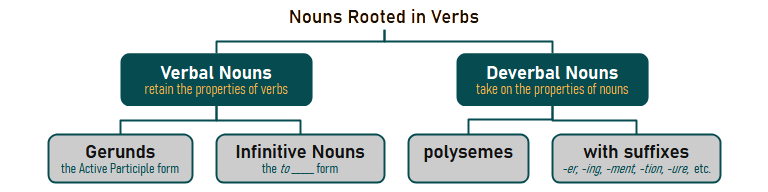
Deverbal Nouns
Gerunds (as defined on this page) specifically retain the properties of verbs, but not of nouns. However, there are some -ing nouns that instead have the properties of typical nouns: they can be specified by determiners or modified by adjectives.
- “My neighbor’s arguing kept me up all night.”
- “Her singing is so lovely, isn’t it?”
- “I just can’t stand his incessant lying.”
These are a type of deverbal nouns (‘deverbal’ meaning rooted in verbs, but no longer retaining the properties of verbs). Other types of deverbal nouns have different suffixes (like ‘commitment’, ‘revolution’, or ’employee’) or no suffix at all (like ‘hammer’, ‘whisper’, or ‘need’)
Sometimes the distinction between Gerunds and non-Gerund participle nouns is muddled, and many instances of -ing nouns are ambiguous in this classification.
Infinitive Nouns
Just as Gerund Phrases are nouns formed from participles, we can have nouns formed from Full Infinitive phrases. This type of verbal noun is not terribly common, but some examples include:
- “To die would be an awfully big adventure.”
- “I would like nothing more than to be with you.”
- “To admit fault is the only way out of this mess.”
Just like Gerunds, these infinitives retain the properties of verbs (like taking on objects or modifiers), but the infinitive phrases act like nouns within their sentences.
Teaching Tips
Verbals
A verbal is any non-finite verb form that is not used as a verb but still retains the properties of a verb. Participles and infinitives can instead act as the head of modifier phrases or noun phrases. Gerund Phrases are a subset of Active Participle noun phrases.
Students should be aware that a word can serve as different parts of speech while maintaining consistency of meaning. For instance, by the time they learn about Gerunds, they might already be familiar with words like ‘answer’, ‘dance’, and ‘paint’, each of which might be a verb in one context but a noun in another. Verbals are like that.
Show students that -ing verbals are just some words that were originally verbs but that can be nouns (or modifiers) depending on how we use them.
Active -ing
Gerunds make use of the Active Participle. The form of an Active Participle has a verb base with an -ing suffix, and it conveys a meaning of action or activity (as opposed to state, passivity, or habit). It often draws attention to the initiation or occurrence of the verb. We see this same participle in Continuous tenses, Active Adjectives, and Verb Patterns. Each time one of these topics arises, point out the Active Participle and help students draw connections to the meaning across each of the related grammar topics that they’ve explored so far.
Insider Access
Visit our How to Teach Gerunds page on www.insightstoEnglish.com for a demonstrational video, bonus notes, printouts, a slideshow for your class, practice activities, and more.
Further Reading
Encyclopedia Pages
- Active Participles — more on the -ing form
- Active Adjectives — the -ing form as adjectives instead of nouns
- Verb Patterns — Gerunds as verbal complements
Insights Articles
- project: Uncommon Hobby WebQuest
- project: Sillylympics
- Define Your Own Terms
Intermediate Topics
CEFR Levels B1-B2: Pre-Intermediate to Upper Intermediate courses